
Loading...
Serving West Lafayette, IN and surrounding areas. (765) 637-4857
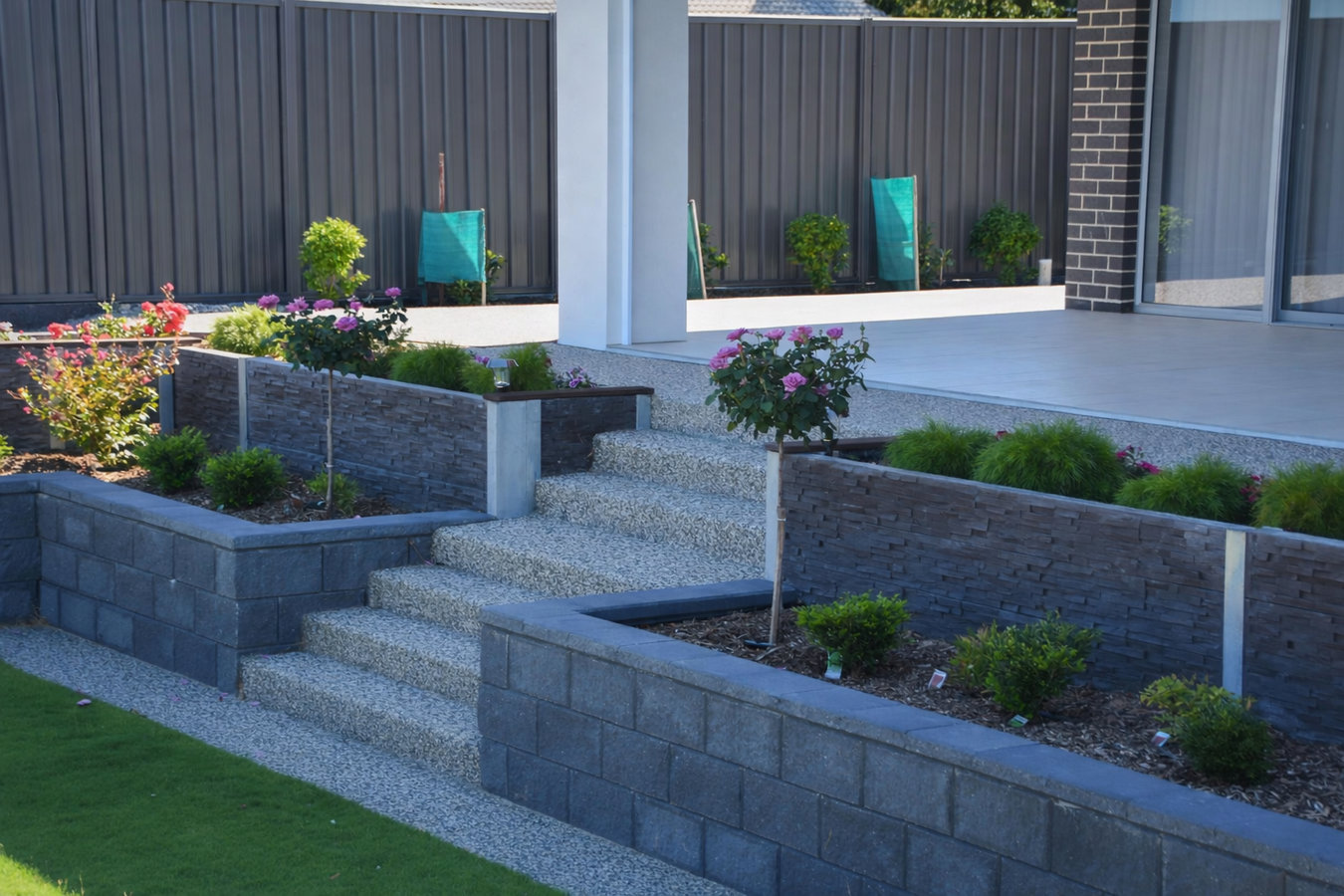
If your yard is sliding toward your driveway or foundation every spring, a concrete retaining wall stops it for good. We build walls designed for West Lafayette's clay soils and freeze-thaw winters, with proper drainage standard on every project.
Concrete retaining walls in West Lafayette hold back soil on a slope or hillside so it does not slide, erode, or push against your foundation - most residential projects run two to five days of active work depending on wall length, height, and how much excavation the site requires. The finished wall can last 50 years or more when drainage is installed correctly behind it, which is the step that separates a wall that holds from one that fails within a few winters.
West Lafayette sits on glacially deposited clay soils throughout Tippecanoe County. Clay holds water rather than draining it, which means the ground behind a retaining wall can become very heavy after rain - putting lateral pressure on the wall that sandy soil never would. The properties near campus and along the Wabash River corridor also tend to have noticeable grade changes where sloped lots, terraced yards, and hillside driveways are common. This is exactly the terrain where a properly built retaining wall earns its keep.
Once a wall is in place, many homeowners pair it with other concrete work to complete the space. Our concrete floor installation and concrete steps construction services work naturally alongside retaining walls to create usable, connected outdoor areas.
If you can see a slow-moving ridge of dirt pushing toward your driveway, garage, or home foundation, that is soil movement - and it will not stop on its own. In West Lafayette's clay-heavy soils, this kind of creep is common on sloped lots, especially after a wet spring. A retaining wall stops that movement before it reaches something expensive.
After a hard rain, do you find channels of washed-out soil, bare patches, or mulch carried down the hill? That is your yard losing ground it cannot get back. West Lafayette gets significant spring rainfall, and sloped yards without proper support lose topsoil season after season - eventually exposing roots and sending sediment toward your foundation.
If you already have a retaining wall - timber, block, or concrete - and it is starting to lean forward, show horizontal cracks, or separate at the base, it is losing the ability to hold back soil. This is a safety issue. A wall that fails can dump hundreds of pounds of soil onto a patio, walkway, or vehicle without warning.
If water collects against your home's foundation after rain, especially after the ground thaws in early spring, a sloped yard may be directing water toward your house instead of away. Left unaddressed, this leads to basement moisture problems that are far more expensive to fix than a properly drained retaining wall.
We build poured-in-place concrete retaining walls and concrete block retaining walls, depending on what your site requires. Poured walls are stronger and better suited for taller applications or locations where a continuous barrier is needed. Block walls work well for shorter decorative borders and raised garden beds. Either way, every wall includes excavation, a gravel drainage layer, a perforated drain pipe, the wall structure itself, and backfill. For homeowners adding flat usable space alongside a new wall, our concrete floor installation service can pour a level patio or walkway surface on the freshly graded area.
If your project involves steps connecting two levels of the yard - which it often does when a retaining wall creates a new grade change - our concrete steps construction service handles that as a natural extension of the wall project. We assess each site in person before quoting, because height, soil conditions, and access for equipment all affect the scope and cost of the work.
Best for taller walls or sites needing a strong continuous barrier - suited to steep slopes and hillside driveways.
Great for shorter walls, raised garden beds, and decorative borders where some visual texture is welcome.
Gravel backfill and perforated pipe behind every wall so water escapes rather than building up pressure.
Multiple shorter walls stepping up a steep slope - creates usable flat areas and reduces pressure on any single wall.
The clay-heavy glacial soils common throughout Tippecanoe County behave very differently from the sandy or loamy soils found in other parts of Indiana. Clay absorbs water and holds it, which means the soil behind a retaining wall can become saturated and extremely heavy after a rainstorm. That extra weight pushes hard against the wall face. West Lafayette's freeze-thaw winters compound this - water that gets behind a wall and freezes will expand and push even harder. This combination is why drainage installation is not an optional add-on for walls built here. It is essential from the first day of the project.
The seasonal window for concrete work in this area runs roughly April through October - once temperatures drop consistently below freezing, pouring and curing concrete becomes much more complicated. Contractors here book up fast once spring arrives. We serve homeowners throughout West Lafayette and nearby Lafayette across the river. The American Concrete Institute provides published guidance on drainage requirements and mix design for freeze-thaw climates - the standards we follow on every wall project.
We come to your property to look at the slope, the soil, and what is nearby before giving you a price. Photos help, but standing on the slope is the only way to assess it properly. You will receive a written estimate within a few days.
Before any work begins, we confirm whether your wall requires a building permit from the City of West Lafayette or Tippecanoe County. If it does, we handle the application - but plan for one to two weeks of lead time for approval.
On the first day, the crew marks the wall footprint and excavates along the base of the slope - sometimes several feet deep to create a stable foundation. We then install a gravel drainage layer and pipe so water cannot build up pressure behind the wall.
The wall goes up - poured in place or block by block depending on your project - then soil is backfilled and compacted behind it. The crew removes equipment, hauls away debris, and walks you through the finished wall before leaving.
Free on-site estimate. We respond within 1 business day and come to your property before quoting - no guesses, no phone estimates.
(765) 637-4857Poor drainage behind a retaining wall is the leading cause of early failure in Tippecanoe County's clay soils. We install a gravel backfill layer and perforated drainage pipe on every wall - not as an upgrade, but as a standard part of every project.
We check permit requirements with the City of West Lafayette and Tippecanoe County before any work begins and handle the application on your behalf. Permitted work is inspected and on record - which protects your investment and your home's value at resale.
West Lafayette's climate cycles through freeze and thaw repeatedly from December through March. We use concrete formulated for cold-weather durability and ensure drainage eliminates standing water - the two factors that determine how long a wall survives here.
We respond to every inquiry within one business day and come to your property in person before providing a written estimate. No guesses, no phone quotes - we look at the slope before we give you a number.
A retaining wall is a long-term investment in your property - one that should hold for decades, not a few seasons. We build every wall with the drainage and structural detail that makes that possible, and we handle the permit process so your project is on record with the city from start to finish.
Level, durable interior slabs for basements and garages - the same quality base prep we bring to every retaining wall project.
Learn MoreSafe, solid concrete steps that work with your retaining wall to connect different levels of your yard or home.
Learn MoreWest Lafayette contractors fill their calendars fast once the ground thaws - reach out now to lock in your project date and get a written estimate at no cost.